Hiển thị các bài đăng có nhãn Kyle Sandilands. Hiển thị tất cả bài đăng

Thứ Bảy, 4 tháng 4, 2015

Published tháng 4 04, 2015 by ana03 with 0 comment

Behind the Scenes with Kyle Sandilands

Kyle Sandilands has been a volunteer with CBT Vietnam since 2011. He graduated from Capilano University’s Motion Picture Production program and has recently completed a new video, The Black H’mong of Lao Chai Village. In just a few days, the video has received over 1,000 views from 33 countries, and is continuing to be shared with viewers from around the world. I asked Kyle a few questions to get a better idea of what this process was like behind the scenes.


Photo courtesy of Kyle Sandilands 

From the initial concept to the final posting online, how long does it take you to create something like this?

It takes a long time to put together a video like this. In this particular video, scenes with Chris Carnovale and Jen Reilly chatting with the H'mong guides on the streets of Sa Pa were shot on my first trip to the region four years ago and did not have a home in the edits of any of the previous videos that focused on the Red Dao in Ta Phin. Telling the story of the Black H’mong guides and sellers in Sa Pa is something we’ve wanted to do for a long time, and now that the CBT Vietnam project has begun to wrap up training in Ta Phin it was only natural that last May’s trip would be the time. We shot it in May, edited a rough cut to screen for the PATA Foundation in September and continued to edit it over the past few months between other projects. It’s great to have it finally online!


Photo courtesy of Kyle Sandilands

How important would you say it is creating materials like this for the Sa Pa region and the H’mong people?

It’s very important. There is so many travellers I meet who know little to nothing about the H’mong or any of the minority groups in the Sa Pa region. Often I hear that the area is too ‘touristy’ or that the sellers are too aggressive. Or that visiting these villages and snapping photos of the people resembles a type of 'human zoo'.

These are all valid concerns, but hopefully with the videos, it can both help share the stories and perspectives of the villagers who call Sa Pa home, and better inform travellers to the area about the positive and negative effects tourism is having on the region, as well as what CBT Vietnam’s role is.

What is your greatest memory or favourite shot that you have gotten throughout this project?

The trip to Hanoi with the Dao women was a pretty amazing experience. Watching the ladies overcome their own hesitations to leave Ta Phin for the big city was incredible to be a part of and to try to see the world through their eyes. Filming the ladies ride escalators for the first time, test out massage chairs and eat sushi was something I’ll never forget. For the newest video, I really tried to showcase just how beautiful and expansive the area is, as well as focus on the intricate details that make up the H’mong culture. Embroidery, batik, harvesting rice - it really is an amazing culture.

What projects are you currently working on, and what can we look forward to seeing from you in the future?

Right now I’m back in Canada working onset on a film in Vancouver, and am in prep on a few more documentary projects.


Photo courtesy of Kyle Sandilands 

What does this project mean to you?
Going to Vietnam with this project in 2011 was absolutely a life-changing experience that opened my eyes to this amazing area and incredible people. It opened the doors to many other interesting projects since, both in Canada and abroad, filming in Africa and South America on a feature documentary for CBC, as well as spending a winter in Yellowknife for History Channel’s Ice Pilots. It’s been hugely important project to me that I’m forever humbled to be a part of.

Kyle, thank you so much for letting us know a bit more about the incredible work you have done for this project! If you haven’t seen Kyle’s latest video yet, please click here.


Read More
      edit

Thứ Hai, 18 tháng 2, 2013

Published tháng 2 18, 2013 by ana03 with 0 comment

Let the preparations begin

To get ready for our time in the villages we have had lots of preparation to do, both in Hanoi and in Sapa. We were joined by Trung, one of the student volunteers from Hanoi Open University (HOU), to assist us with our errands in Hanoi and smooth the language barrier. Trung and Rachael purchased supplies, and got CBT business cards printed at a local print shop. 


We got our business cards printed. Can you find Kyle Sandilands card?

We met Ms. Ngoc Anh, the project lead at HOU, to refine our itinerary and finalize our plans. We also took some time to deliver invitations to a number of tour operators for the private sector workshop that the CBT team is facilitating next weekend. 

Ms. Ngoc Anh, Jen and Nic discussing logistics

We arrived in Sapa early this morning and we're off to a great start. We went for lunch with Peter Gilbert, from Sapa O'Chau, to discuss the private sector workshop. Sapa O'Chau will be hosting the workshop next weekend in their new facility. We are currently in the process of connecting with local tour operators to follow up with them about the private sector workshop.

On the training side of things, we have been out in the community connecting with people from Ta Phin and Lao Chai to let them know we are here and that we will be delivering training and working with people in the villages this week.
 

Jen connecting with women from Lao Chai

The HOU team, Ms. Ngoc Anh, Ms. Huyen and Trang, will be taking the night train to Sapa tonight to join forces with us. From there we will be making the game plan for the next week.
Read More
      edit

Thứ Năm, 22 tháng 11, 2012

Published tháng 11 22, 2012 by ana03 with 0 comment

The First 72 Hours - A Filmmaker's Perspective


“What are you doing next week?  Do you have a passport?!” 

It’s a rainy Tuesday morning in Vancouver, and I’m riding on a city bus on the way to shoot a video about seeing-eye dogs at a local animal shelter, when I get the most important phone call of my life.

“There’s a project going on in Vietnam, and they need a guy to come out and film what they’re doing.”

Trying to sound unfazed, I hide my obvious enthusiasm at the thought of simply packing up and heading around the world in under a week’s time as Bill Thumm, the director of the Bosa Center of Film & Animation, continues on.

“They can meet up on Thursday afternoon, will that work for you?”

And just like that, in two days time, on that Thursday afternoon meeting, my life was about to change forever.  I met the Chrises: Dr Chris Bottril, Dean of Capilano University’s Tourism program, and Chris Carnovale, the project’s logistics guy and resident ‘fixer’. 

The crash course interview, where only moments before meeting the pair did I finally get a chance to check out the CBT Vietnam website and get familiarized with who the Dao and Hmong peoples were and where they lived around Sapa, was a memorable one. 

As Chris Carnovale, or Carno - as we like to call him - asked me about my past travel experience, only to realize that apart from a few road trips and a couple all-inclusive escapes to Mexico and Cuba I was pretty green, I saw his face go sickly pale, and the stress levels go up.

“I don’t care what you’re doing on this trip.  I just need to know if you’re going to freak out because that can’t happen. And we won’t be able to wait around for you.” 

Chris Bottril, on the other hand, told me more about the project, about sustainable tourism and about what our goals were as well as ideas on how to get them across in the video.  I was immediately both interested and excited about the project, and given my experience working on film sets where a short day on set clocks in around 12 hours, and you routinely find yourself in uncomfortable situations, dealing with opposing personalities and sometimes polarizing team dynamics, I felt pretty confident that I’d be able to come in and get the job done.  Or at least show up and not freak out in the airport.

I felt that I’d be fine out there, but how do you really know?  Working and dealing with challenges and situations in a culture that is about as far removed as it can be from what we deem to be normal seemed to be a big question mark.  And then dealing with the pressures of shooting a documentary and playing the role of director, cameraman, and editor wouldn’t make the gig any easier.

A phone interview with team leader, Jen Reilly followed the conversation with the Chrises, and it became clear that I was going to be a part of this trip.  But it also became clear that I had under 72hrs to completely prep and organize a camera package to film a short documentary about a subject I had no idea or past knowledge about. 


In addition, it became clear that getting an extra round-trip ticket to Hanoi, an extra Vietnamese visa, four travel vaccination shots, passport photos, and all the other basic preparations you’d make for a trip across the globe had to now be dealt with in a compressed amount of time.

To say that everything that needed to happen for the film to be made was impossible, which at times I felt, would not be acceptable.  No couldn’t be an option. 

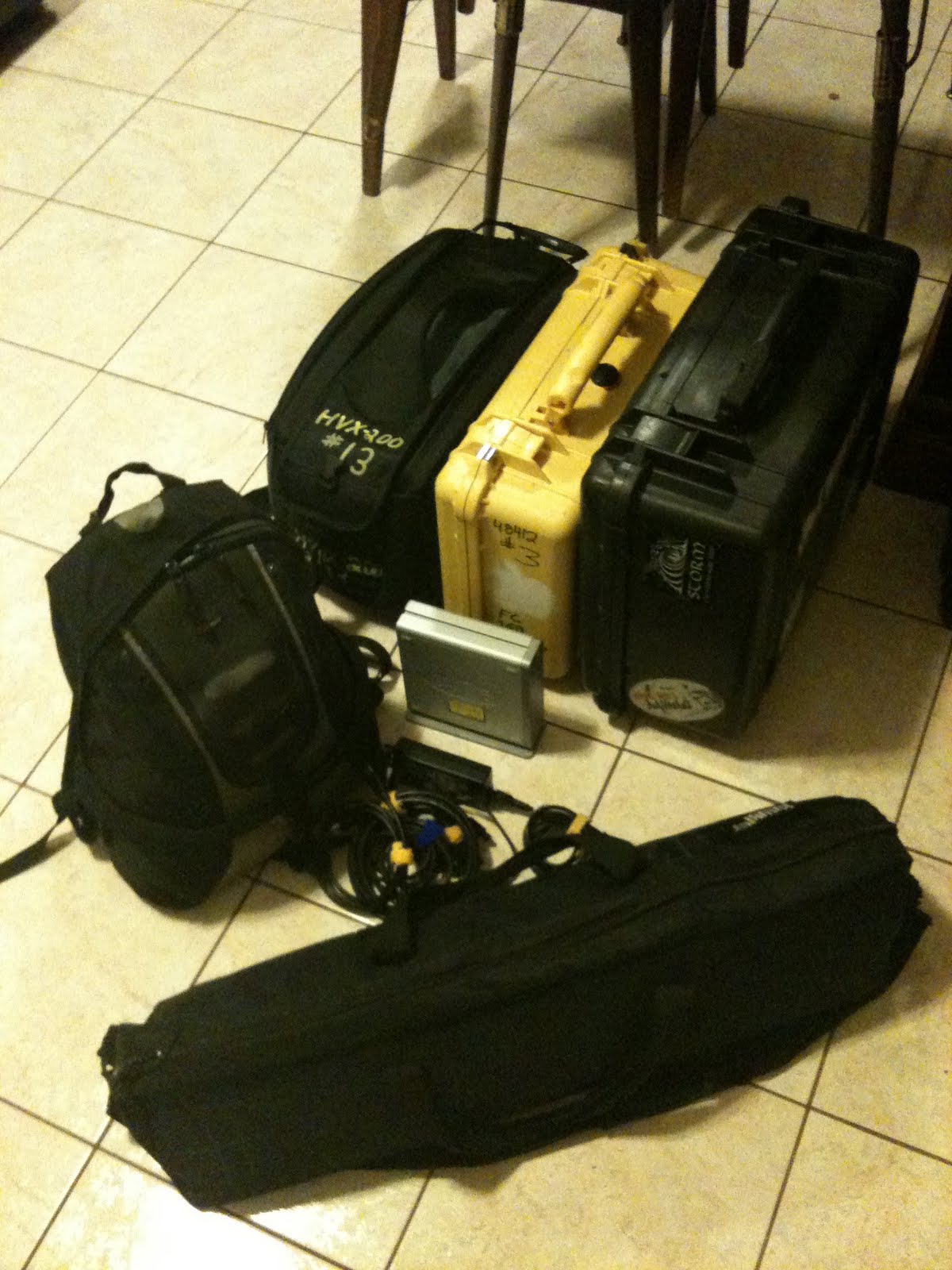
I had no way of testing a lot of the gear I’d be bringing over to Vietnam; an old Macbook G4 laptop, the only one available for us to use, for example, frequently crashed while we tried turning it on in the studio.  One of the hard drives that we’d copy media onto in the field was duct-taped together.  Another drive had a horrible buzzing noise when plugged in.  

The extra expense and stress that my surprise involvement automatically added to the not-for-profit-project certainly made the pressure on myself to be fully ready and able to film on day one in Vietnam all the more greater.  I took videotapes to record onto as a last resort if the laptop, hard drive or main camera failed - the equivalent of planning to record a symphony orchestra piece on an old cassette tape.

And as I continued sorting through and testing the equipment from the Bosa Centre for Film and Animationat Capilano University, Chris Bottril called to reveal to me that whatever this film that I was creating was - I still wasn’t completely sure myself - that it had to be completely finished and ready to be screened at the PATA Foundation Conference taking place in less than a week after we’d return.

Crazy? Sure. Impossible? Nope. By this point my flight with the team was scheduled, my Visa greased past Vietnamese immigration far quicker than the typical processing period, and I was able to get all my vaccines, malaria pills, and film equipment locked-down and ready for departure.

Planning ahead to cutting a video in 8 days?  Why not?  It’s not like it would be any crazier than everything that had come at me so far…

As the hours grew nearer to departing, with myself mentally going through what it was I was about to be getting myself into, I knew that without a doubt, my life would be changing as a result of being involved in this project.

And over a year after that first trip in March 2011, and the two project trips since, I know, without a doubt, that my life path has absolutely shifted gears.

The opportunity to spread a message, to share a story through video or new media is one that has the potential to emotionally engage and affect audiences in ways that simply cannot be expressed when written in articles, new stories, or books.

Having the opportunity to go in and film a story about the positive and negative impacts that tourism can have on sensitive ethnic communities was an eye-opening personal and professional experience. It was an incredible experience, one I’ll never forget; and it has since made me want to continue to search for stories that are important. Stories that are original.  Stories that are meaningful, and stories that are full of emotion.  

Stories that every writer, journalist, and filmmaker strives to find.  They are the stories that have the potential to make an impact to the world; they are the stories that have the potential to inspire.

Whether it be sharing to the world a remarkable individual’s unique accomplishment, an ordinary family’s daily life and routine, or a dying culture’s last chance to be heard by a wider audience, searching for and sharing stories that have the potential to make differences is something I would like to strive to achieve over the next few years. 
And I hope that it's something we can continue to share to people all over the world with the CBT Vietnam project.
Kyle


To see the video's Kyle has shot for the Capilano University / PATA Foundation Vietnam Training Project you can check out the project's website or YouTube channel.
Read More
      edit

Thứ Sáu, 16 tháng 11, 2012

Published tháng 11 16, 2012 by ana03 with 0 comment

The Past 72 Hours - A Filmmaker’s Perspective


The past 72 hours has seen our second film, When the Village was Heard for the CBT Vietnam project erupt with views, shares and support from around the world; and, it’s been an exciting thing to witness as a filmmaker.  I suppose it’s a bit like watching your kid leave home and head off to college.  You’re not really sure what people will make of your son or daughter; whether it’ll stand out and make you proud, or if it will simply go out and slip into the crowds of videos that make up YouTube.  (A recent stat says that 48 hours of video is uploaded to YouTube every minute - nearly eight years of content every day!!)

With this second video, we really tried to make the focus less about the Canadian/Vietnamese group delivering the training, and more about the women telling their story in their own words.  As Dao language is their native tongue, it made sense to do as many of the interviews with the women in Dao as possible, sometimes creating the need to double translate from English to Vietnamese to Dao.  A big thank you has to go Ly Lo May who spent several hours going through the video in the editing room (which in this film’s case, happened to be various coffee shops in Hanoi), helping translate the Dao language into English.

Hearing the women speak in their own language, confidently and comfortably, is something that, as a filmmaker, I’m most proud of with this new video.  We took great strides to make sure the translations were accurate, and it’s a fascinating language to listen to - very different than Vietnamese or other South Asian languages.  Dao is an oral language, one that cannot be written on paper, and it has become something that I’d like to pretend that I’m unintentionally learning, after watching and listening to the footage for hours upon hours.

I lived in Hanoi for three months this past spring where the majority of this video was edited.  Living in the Old Quarter of Hanoi in a hotel room without A/C was an experience I’ll never forget, and I have many thanks for the cool floor tiles, and the electric fan that saved my life and kept the MacBook Pro alive and running fine.

Cutting a video down from the hours and hours of raw content into its current length is never an easy task, and like the first video, there were a lot of ideas and issues to get across in a six-minute piece.  The goal for this video was to show the progress that has been made as a result of the project training through the eyes of the Dao women.  We also wanted to show the great risks that the women are taking in order to build tourism in their village.  Chao Ta May, for example, has invested 75 million Vietnamese dong, roughly $3700 USD to make improvements to her homestay.  If tourism dries up, she and her family have a very real problem.

Topics such as the successes of the temporary community market and how it’s providing a place for the elderly women to sell were important to showcase.   Of course we also wanted to feature the tour operators meeting the Dao women in Sapa, the cooperation between the government, private organizations and Capilano University and Hanoi OpenUniversity.  And we wanted to set up how training is beginning to take shape in the neighboring Black H’mong community of Lao Chai.

This last week has been an exciting one.  And as we approach 1000 hits, I have a lot of people to thank.  Bill Thumm, probably first and foremost, for thinking of me and putting me in touch with Chris Bottril and Chris Carnovale in a last minute meeting to have a videographer film what became When the Tourists Come. Last year’s video had us borrowing a lot of camera equipment from the Bosa Centre for Film and Animation on incredible short notice (72 hours!!)  Chris Curran-Dorsano and the rest of the studio team did a great job in hooking us up with gear, and I was very happy to be able to bring it back in one piece..  Sorry about the mud guys.

Many thanks need to go to the team members on the each of the project trips I’ve been a part of now  (three so far!).  Helping schlepp gear around Hanoi and in the villages, rounding up interviewees and simply working out logistics to make my job easier are all big reasons for the videos turning out the way they do.  And it’s that unseen help that is so important in this style of small-unit documentary filmmaking.  And a shout-out to Capri Studios and composer Luke Dunn for the great work on the original music created specifically for this video. 

Thank you to the PATA Foundation, the generosity of whom is now being seen all around the world.   

Thanks also have to go to the women themselves, for allowing me into their homes and to interview them on camera.  They are fantastic, and when you put them in front of the camera and attach the mic to their lapels, they have the same kind of nervousness and pre-interview jitters as anyone else.  But they did a great job of speaking on camera, better than many English-speaking interviewees I’ve interviewed here in Canada.

To get the kind of international exposure in making videos such as these, and to be able to travel and see another side of the world and it’s unique and remarkable culture, is something that has absolutely changed my perspective.

To get to know and befriend the Dao women, to be able to go inside their homes and document their incredible stories has been a tremendous privilege, and an absolute pleasure to be a part of.  It’s hard work.  Mentally, physically and psychologically challenging.  You’re in a place where extreme poverty is all around you, and it’s something you absolutely must be able to adapt to.

But I have no regrets in being a part of these videos and I can only hope that there are more projects like these around the corner.  More stories to be told.  More long days of editing in foreign countries in air-conditioning-less hotels.

It’s been a fantastic project to be a part of, and I hope people enjoy the videos and find themselves wanting to learn more about what’s going on in the CBT Vietnam universe. Thanks again for joining us over the last 72 hours, as we launch this video, and share what so many have been a part of. 

Cheers,

Kyle


Read More
      edit

Thứ Ba, 13 tháng 11, 2012

Published tháng 11 13, 2012 by ana03 with 0 comment

When a Village was Heard - Capilano U / PATA Foundation Tourism Project (Sapa, Vietnam)

Here it is! The NEW video by the CBT Vietnam team. We hope you enjoy it! Please fell free to comment below - we love hearing your feedback!


A community tourism training project in the Sapa region of Northern Vietnam operated by Capilano University Vancouver, Canada, and Hanoi Open University, Vietnam, and supported by the PATA FoundationThe project features tourism training to help sustain vulnerable ethnic cultures and maximize benefits of tourism to small and unique villages in Northern Vietnam. Training is done by Capilano and Hanoi Open University students and faculty.

This video is illustrative of a second two-year project that will look to enhance networks between the village of Taphin and private sector tourism companies. The project will also deliver tourism training in the Hmong community of Lao Chai. 


This video was scripted by Chris Carnovale, Chris Bottrill and Kyle Sandilands, and filmed and directed by Kyle Sandilands (www.kylesandilands.ca).
Read More
      edit

Thứ Tư, 14 tháng 3, 2012

Published tháng 3 14, 2012 by ana03 with 0 comment

Kyle Sandilands to join us again!

I am having the pleasure of enjoying a Vietnamese coffee with my good friend Kyle Sandilands, who joined the CBT Vietnam team once again in Vietnam. Kyle Sandilands, a grad from Capilano U's film program, joined us last March when he filmed some of the project activities.

Kyle's last film, shown below, was a huge hit with the everyone who has had the opportunity to see it. So far the short film has been seen in over 30 countries and to thousands of people.

Kyle has decided to base himself in Hanoi for the next month, as he cuts a second short clip for PATA's Annual General Meeting in Kuala Lumpur this April. He is also currently working on a web series for the project that is due to come out soon!
Read More
      edit